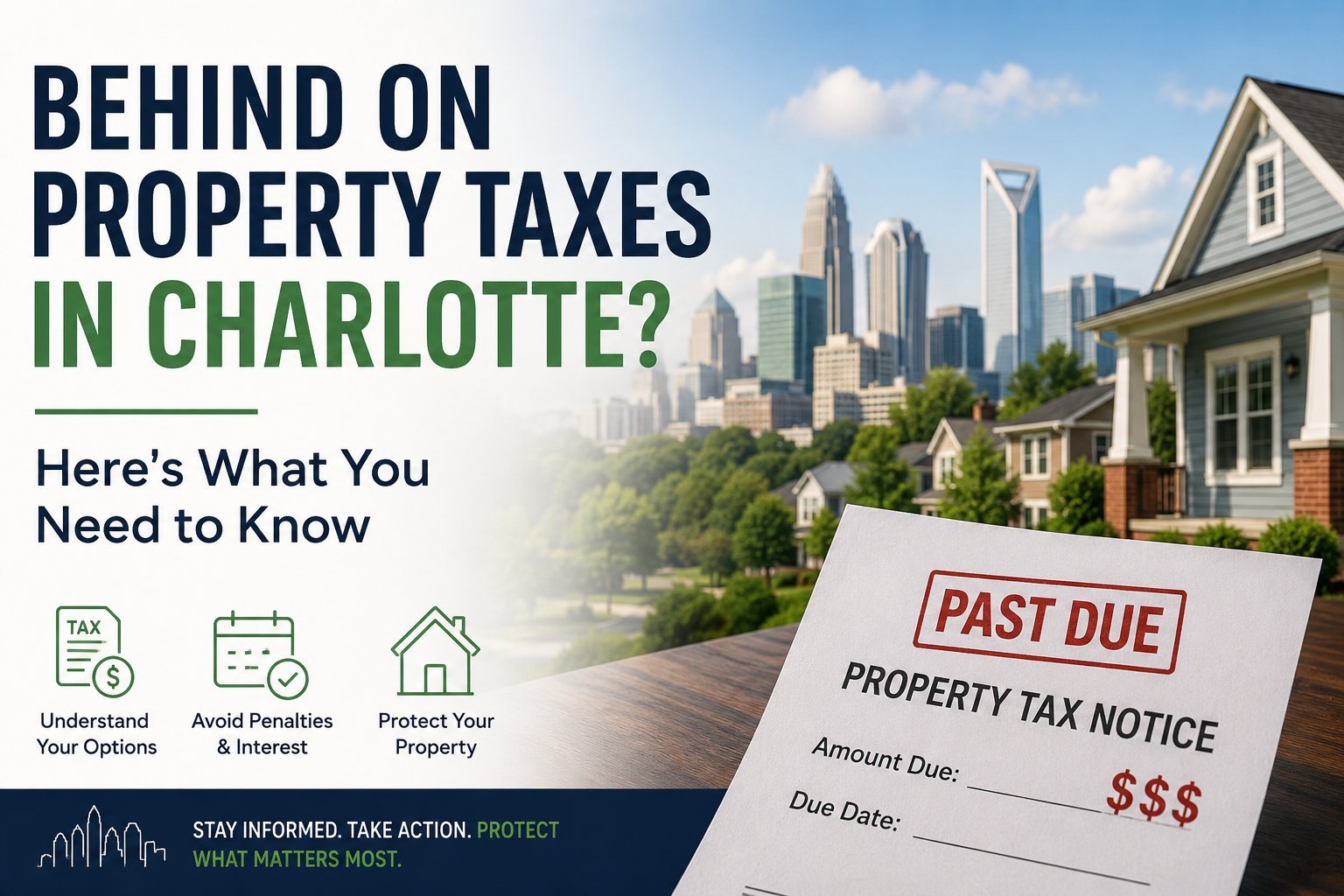
Falling behind on property taxes is more common than most Charlotte homeowners realize — and more urgent than it feels.
Unlike a credit card bill, an unpaid property tax bill is tied directly to your home. It becomes a lien, it accrues interest every month, and in North Carolina it can eventually lead to the county foreclosing and selling your house to collect what's owed. The good news: you almost always have time and options if you understand the process early.
This guide breaks down exactly what happens when you fall behind on property taxes in Charlotte and Mecklenburg County — the deadlines, the interest, the lien, the foreclosure timeline, and the realistic ways to resolve it before you lose the home or your equity.
The Bottom Line Up Front
Unpaid property taxes in Mecklenburg County start accruing interest on January 6 and become a lien on your home. The county can pursue tax foreclosure, but you can stop it by paying what's owed — or by selling the home before the sale is finalized, which pays off the lien and lets you keep your remaining equity.
When Do Charlotte Property Taxes Become Delinquent?
In Mecklenburg County, property tax bills are typically mailed in July, and you have until January 5 of the following year to pay without penalty. Payments received or postmarked after that date are considered delinquent.
Once a bill is delinquent, two things start happening immediately: interest begins to accrue, and the unpaid amount becomes an enforceable lien against your property.
One important detail many homeowners miss: under North Carolina law, not receiving your tax bill in the mail does not excuse the tax or the interest. The obligation stands whether or not the bill reached you.
How Much Interest Do You Pay on Late Property Taxes in NC?
North Carolina sets the interest on delinquent property taxes by statute, and Mecklenburg County applies it the same way every year:
- 2% interest for the first month — added starting January 6
- 0.75% (three-quarters of one percent) for each additional month — or any part of a month — until the balance is paid in full
That means a bill left unpaid for a full year carries roughly 2% + (11 × 0.75%) = about 10.25% in interest on top of the original tax. And interest cannot be waived — not for hardship, and not even if you have a pending appeal of your property's assessed value.
Interest Keeps Compounding the Longer You Wait
Because the 0.75% monthly charge applies to "any part of a month," paying even one day into a new month triggers another full month of interest. The cost of waiting is real and predictable — which also means catching up sooner always costs less than catching up later.
What Happens After Your Taxes Go Delinquent
Mecklenburg County doesn't jump straight to taking your home. The Office of the Tax Collector generally works through a series of escalating collection steps first, giving owners multiple chances to resolve the debt.
Reminder Notices
Before and shortly after the January 5 deadline, the county sends reminder postcards and notices encouraging payment before interest and enforced collection begin.
Cheapest time to resolve — little or no interest yetInterest & Lien Attach
Starting January 6, interest accrues monthly and the unpaid taxes become a lien on the property. The lien must be satisfied before the home can be sold or refinanced with clear title.
Window open: pay, set up arrangements, or sellPublic Advertisement
Each spring, North Carolina law requires the county to publish the names of delinquent taxpayers and the principal they owe — in Mecklenburg County, this runs in The Charlotte Observer, often listing tens of thousands of owners.
Your delinquency becomes public recordEnforced Collection
The Tax Collector can garnish wages and bank funds, seize and sell personal property, and intercept North Carolina income tax refunds and lottery winnings to satisfy the debt — none of which require the public advertisement first.
Window narrowing fastPre-Foreclosure Letter & Foreclosure
As a final step, the county sends a pre-foreclosure letter to the owner's last known address. If the debt still isn't resolved, the parcel can be assigned to an attorney to begin tax foreclosure under N.C. Gen. Stat. 105-374, leading to a public sale of the home.
Last chance: a sale can still pay off the lien if you act in timeHow Tax Foreclosure Works in North Carolina
When pre-foreclosure efforts fail, Mecklenburg County may assign the property to a private attorney to file a tax foreclosure. North Carolina's most common method is an "in rem" or mortgage-style foreclosure under N.C. Gen. Stat. 105-374, where the court authorizes a public sale of the property to satisfy the unpaid taxes, interest, and costs.
A few things make tax foreclosure especially important to understand:
- The tax lien generally has priority — it often outranks most other liens on the property, including some mortgages.
- The county only needs to recover what it's owed — taxes, interest, and legal costs — not maximize your sale price.
- You can stop it by paying off the debt — taxes, interest, and costs — before the sale is confirmed.
Like a mortgage foreclosure, a tax foreclosure sale in North Carolina is followed by a 10-day upset bid period before it becomes final, during which a higher bid can reopen the bidding. Until that sale is confirmed, you still have a window to resolve the debt or sell.
Tax Foreclosure vs. Mortgage Foreclosure
These are two different things. A mortgage foreclosure is started by your lender for missed loan payments; a tax foreclosure is started by the county for unpaid taxes. A home can even face both. If you're behind on your mortgage too, read our companion guides: What Happens If You Miss Mortgage Payments in NC and the North Carolina Foreclosure Timeline.
Will a Property Tax Lien Hurt My Credit?
This worries a lot of homeowners, but the answer is more nuanced than people expect. The three major credit bureaus generally no longer include tax liens on consumer credit reports, so a property tax lien may not directly lower your credit score the way a missed loan payment does.
That said, a tax lien is still a serious problem:
- It's a public record attached to your property's title.
- It blocks a clean sale or refinance until it's paid off.
- It keeps growing with monthly interest.
- A completed tax foreclosure can have lasting financial consequences.
In other words, ignoring it because "it won't hit my credit" is a costly misunderstanding.
Your Options If You're Behind on Property Taxes
Most Charlotte homeowners behind on property taxes have more than one path forward. Which one fits depends on how far behind you are and whether you can realistically catch up.
| Option | Best for | Things to know |
|---|---|---|
| Pay in full | Short-term cash crunch, recoverable | Stops interest immediately; cheapest if done early |
| Payment arrangement | Owners who can pay over time | Contact the Mecklenburg Tax Collector early to ask what's available |
| Tax/escrow review with lender | Escrowed mortgages | If your lender pays taxes from escrow, an escrow shortage may be fixable through them |
| Sell the home | Can't catch up, or taxes are one of several problems | Lien is paid at closing; you keep remaining equity and avoid foreclosure |
If you have equity in the home — and in Charlotte's market, many owners do — selling before a tax foreclosure is often the cleanest way to protect that equity. The unpaid taxes simply come out of the proceeds at closing, the lien is cleared, and you walk away with the rest instead of leaving it on the courthouse steps.
Can I Sell My House If I Owe Back Property Taxes?
Yes — and it's one of the most common reasons homeowners call us. You can sell at any time before a tax foreclosure sale is finalized.
Here's how it works in practice: at closing, the title company or attorney pays the delinquent taxes, interest, and any fees directly from the sale proceeds. The lien is released, the buyer gets clear title, and you receive whatever equity remains after the payoff.
This is true even if:
- The home needs repairs — many cash buyers purchase as-is.
- You inherited the property with back taxes already owed.
- You're also behind on the mortgage.
- The delinquency has already been advertised publicly.
If you'd like to compare a traditional listing with a direct cash sale for a tax-burdened property, our home selling comparison lays out the trade-offs. And if the back taxes are tied to a house you inherited, that guide walks through the extra steps involved.
How Fast Can a Cash Sale Resolve It?
A cash sale can typically close in about 7 to 14 days — often well before a tax foreclosure sale is finalized — because there's no lender financing or appraisal to wait on. The main constraint is the few business days the title company needs to clear title and handle the lien payoff. As long as the sale closes and satisfies the taxes before the foreclosure is confirmed, it resolves the debt cleanly.
Common Mistakes Homeowners Make With Delinquent Taxes
Assuming the County Will Wait Years
There's no guaranteed grace period. While Mecklenburg County usually sends several notices first, it isn't required to wait a set number of years before foreclosing.
Ignoring It Because "It Won't Hit My Credit"
The lien still grows, still blocks a clean sale, and can still end in foreclosure — credit reporting is the least of the concern.
Waiting Until the Foreclosure Notice Arrives
By then, interest and legal costs have piled up and your window has narrowed. Acting while the debt is small keeps the most options open.
Draining Savings to Cover a Home You Can't Sustain
If the taxes are one of several costs you can't keep up with, pouring savings into them may only delay the inevitable. Sometimes selling and resetting is the financially healthier move.
Charlotte & Mecklenburg County Tax Resources
Official Resources for Homeowners Behind on Property Taxes
- Mecklenburg County Office of the Tax CollectorPay your bill, look up balances, and view delinquent tax information
- Mecklenburg County Delinquent Taxpayer ListsHow enforced collection and foreclosure are handled
- NC Delinquent Property Tax Rules (overview)Plain-English summary of interest, liens, and tax sales in NC
- NC Housing Finance AgencyFree housing counseling that can include tax and mortgage hardship
Frequently Asked Questions: Behind on Property Taxes in Charlotte
What happens if you don't pay property taxes in Mecklenburg County?
The unpaid amount becomes delinquent after January 5, starts accruing interest on January 6 (2% the first month, then 0.75% monthly), and becomes a lien on your home. The county can publish your name, pursue enforced collection, and ultimately foreclose to sell the property and satisfy the debt.
How long can property taxes go unpaid before foreclosure in NC?
There's no fixed number of years. Once taxes are delinquent the county can begin foreclosure at any time, though in practice it usually sends multiple notices and a final pre-foreclosure letter first. Many owners have months to act, but the county isn't required to wait.
Can I sell my house if I owe back property taxes?
Yes. You can sell any time before a tax foreclosure sale is finalized. The delinquent taxes are paid from the sale proceeds at closing, the lien is cleared, and you keep the remaining equity.
How much interest do you pay on late property taxes in NC?
2% for the first month (starting January 6) and an additional 0.75% for each month or part of a month after that, until paid. Interest can't be waived, even with a pending value appeal.
Does a property tax lien hurt my credit?
Tax liens are generally no longer on consumer credit reports, so the lien itself may not lower your score. But it's a public record on your title, it blocks a clean sale or refinance, and a completed tax foreclosure can still cause serious harm.
What if I inherited a house with unpaid property taxes?
The lien stays with the property, so the back taxes must be cleared before or when the home is sold or transferred. Many heirs sell the home as-is to a cash buyer who handles the lien payoff at closing. Our inherited house guide covers the full process.
Can the county really take my home over unpaid taxes?
Yes. North Carolina law allows local governments to foreclose on real property for delinquent taxes and sell it at public sale. You can stop it by paying the taxes, interest, and costs before the sale is confirmed.
Is a cash sale faster than dealing with a tax foreclosure?
Usually. A cash sale can close in about 7 to 14 days, often before a tax foreclosure is finalized, and the buyer clears the lien at closing. If your tax situation is urgent, call us at (704) 235-3008 and we'll tell you honestly whether we can close in time.
Final Thoughts
Being behind on property taxes in Charlotte isn't a dead end — but it's also not something that quietly resolves itself. Interest compounds every month, the lien follows the property, and the county does eventually act.
The homeowners who come out of this in the best shape are the ones who face the numbers early: find out exactly what's owed, look at their equity, and choose a path while they still have options. For some, that's catching up or setting up an arrangement. For others, selling before foreclosure protects the equity they've built and ends the stress.
If you're behind on property taxes in Charlotte or anywhere in Mecklenburg County and want to understand your options without pressure, the team at Carolina Easy Home Sales can help you figure out what your home is worth and whether a sale makes sense. Call us anytime at (704) 235-3008.
This Article Is Informational, Not Legal or Tax Advice
Property tax rules and foreclosure outcomes depend on your specific situation. For guidance, consult the Mecklenburg County Tax Collector, a North Carolina tax attorney, or a HUD-approved housing counselor before making decisions.