
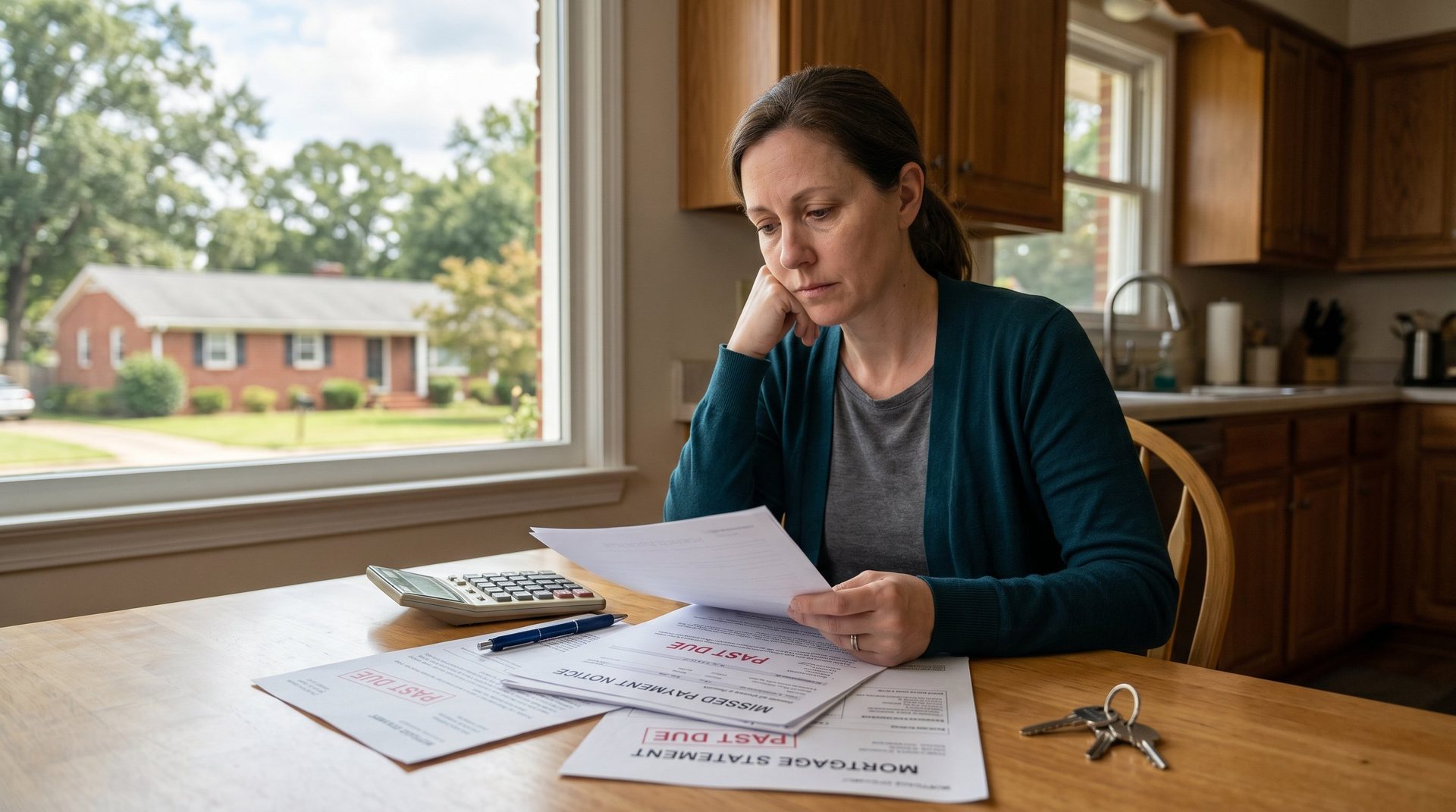
Missing a mortgage payment in North Carolina can snowball faster than most homeowners expect.
One late payment might only lead to a fee and a few stressful phone calls. But after 90 to 120 days, many lenders begin the foreclosure process. The Consumer Financial Protection Bureau explains that, in most cases, the legal foreclosure process cannot begin until a borrower is at least 120 days behind on a mortgage.
In North Carolina, foreclosures can move quickly because the state primarily uses a non-judicial foreclosure system, also known as a power of sale foreclosure. The North Carolina Judicial Branch explains how foreclosure hearings, sales, and upset bid periods work under the state's foreclosure process.
That means homeowners often have less time to react than they think.
If you're behind on payments in Charlotte or anywhere in North Carolina, this guide explains exactly what happens next, what your lender can legally do, and the options available before foreclosure becomes final. Most importantly, you'll learn how to avoid making panic decisions that cost you equity.
Quick Answer: What Happens After Missed Mortgage Payments in North Carolina?
If you miss mortgage payments in North Carolina, here's the typical timeline:
- 1 missed payment, 1–30 days late: Late fees and lender contact begin
- 2 missed payments, 30–60 days late: Credit damage increases and collection efforts intensify
- 3 missed payments, 90+ days late: Lender may issue a Notice of Default
- 4+ missed payments, 120+ days late: Foreclosure proceedings often begin
North Carolina lenders can foreclose without filing a traditional lawsuit in court. This speeds up the process compared to judicial foreclosure states.
Once foreclosure starts, homeowners may have limited time to catch up on payments, difficulty refinancing, and a rapidly shrinking window to sell the home traditionally.
For many distressed homeowners, selling before foreclosure becomes public record protects both credit and remaining equity. If you're trying to understand whether a direct sale could work for your situation, you can review how the process works through our simple 3-step process.
The Bottom Line Up Front
Missed payments do not mean you lose your home tomorrow. But every option you have — reinstatement, modification, refinance, or sale — has a window that closes as the clock runs. The earlier you understand your numbers, the more control you keep over the outcome.
Why Homeowners Miss Mortgage Payments
Most people don't miss payments because they're irresponsible.
In our experience, the biggest reasons North Carolina homeowners fall behind include:
- Job loss or reduced income
- Medical debt
- Divorce or separation
- Unexpected major repairs
- Rising adjustable-rate mortgage payments
- Death in the family
- Property tax increases
- Insurance premium spikes
Charlotte homeowners have felt additional pressure from rising living costs and higher monthly escrow payments over the past few years.
A lot of homeowners wait too long before taking action because they assume the problem will fix itself in a month or two. Sometimes it does. Often, it doesn't. And the longer someone waits, the fewer options remain.
The North Carolina Mortgage Delinquency Timeline
First Missed Payment: Days 1–30
After your first missed payment, your lender usually charges a late fee after 10–15 days, collection calls and notices begin, and your mortgage may be reported late to credit bureaus after 30 days.
At this stage, foreclosure is not immediate. Most lenders would rather work out a payment solution than foreclose — foreclosure is expensive for banks too.
If this is your first missed payment, contact the lender immediately. Many homeowners avoid calls because they're embarrassed. That mistake often makes things worse.
Second Missed Payment: Days 30–60
By the second missed payment, credit damage becomes more serious, collection activity increases, and your lender may discuss loss mitigation options.
This is usually when homeowners start using savings, credit cards, or retirement funds to keep up. That can buy time. But it can also create a second financial crisis.
One pattern we've seen repeatedly in Charlotte is homeowners draining retirement accounts to delay foreclosure by only a few months. In many cases, selling earlier would have preserved far more cash.
Third Missed Payment: Days 60–90
After three missed payments, your loan is typically considered in serious default, lenders may send a formal breach letter or Notice of Default, and foreclosure preparation often begins internally.
At this point, reinstating the mortgage usually requires past due payments, late fees, legal fees, and additional penalties.
Many homeowners underestimate how large the reinstatement amount becomes. A mortgage that's "only" three months behind can require thousands more than expected to catch up.
Fourth Missed Payment: 120+ Days Late
Federal mortgage servicing rules generally prevent lenders from starting foreclosure until a loan is more than 120 days delinquent. The CFPB confirms that, except in rare cases, mortgage servicers generally cannot start foreclosure until at least 120 days after delinquency.
After that, the lender may formally begin foreclosure proceedings, a hearing date may be scheduled, and notices become public record.
This is when distressed homeowners often begin searching for "how to stop foreclosure in North Carolina," "sell my house fast Charlotte," or "can I sell my house during foreclosure?" The answer is usually yes — but timing matters.
"Non-Judicial" Does Not Mean "No Court Involvement"
Despite the name, North Carolina's "non-judicial" foreclosure still runs through the court system — specifically the Clerk of Superior Court. The difference is that it doesn't require a full lawsuit, which is exactly why it moves faster than judicial foreclosure in other states.
The Real Cost to Reinstate a Mortgage in North Carolina (With Example)
Here's the single most underestimated number in this entire process: the reinstatement amount — the lump sum it takes to bring your loan current and stop foreclosure without paying off the whole mortgage.
Most homeowners assume reinstating means simply paying back the payments they missed. It doesn't. In North Carolina, the reinstatement (or "cure") amount typically includes your missed principal and interest payments, accumulated late charges, any escrow shortage for taxes and insurance, property inspection and preservation fees the servicer added along the way, and — once the file reaches an attorney — foreclosure legal fees and costs.
That last category is the one that surprises people. North Carolina foreclosure attorney and trustee fees commonly run in the $2,000–$3,300 range, and depending on how the debt is pursued, allowable attorney fees can be calculated as a percentage of the balance owed. Add it all together and a loan that's "only" a few months behind can cost far more than a few months of payments to reinstate.
Worked Example: A Charlotte Homeowner 4 Months Behind
Say your normal mortgage payment is $1,850/month (principal, interest, taxes, and insurance) and you're four payments behind heading into a foreclosure filing. A realistic reinstatement quote might look like this:
| Line item | Estimated amount |
|---|---|
| 4 missed payments ($1,850 × 4) | $7,400 |
| Late fees (~5% of the P&I portion, per missed payment) | $280 |
| Property inspection / preservation fees | $45 |
| Escrow shortage (tax/insurance true-up) | $600 |
| Foreclosure attorney & trustee fees / costs | $2,800 |
| Estimated reinstatement total | ≈ $11,125 |
So the homeowner who budgeted "about $7,400 to catch up" is actually looking at roughly $11,000+ in certified funds — and that number keeps climbing every month the default continues, because new interest, new fees, and additional legal costs keep accruing. These are illustrative figures; your servicer must provide an exact, written quote.
Always Get the Reinstatement Amount in Writing
Under North Carolina practice, you can request a written reinstatement (cure) figure with a specific "good through" date, and servicers generally must provide a payoff statement within about 10 days of a request. Get both numbers in writing before you make any decision — guessing at the cost is how homeowners drain savings and still lose the house.
Why This Number Matters So Much
- If you can comfortably cover the full reinstatement amount in certified funds, reinstating may be your cleanest path to keep the home
- If covering it would drain your savings or retirement — and the monthly payment is still unaffordable — you may be buying a few months at enormous cost
- The reinstatement figure is also your honest yardstick for the "catch up vs. sell" decision later in this article
What Happens After the 120-Day Mark: The Hand-Off to Foreclosure
Once you cross roughly 120 days delinquent, your file typically moves from your servicer's collections department to a foreclosure attorney. This is the moment the situation stops being a "missed payments" problem and becomes a legal proceeding. In North Carolina's non-judicial "power of sale" process, that means a Notice of Hearing filed with the county Clerk of Superior Court, a limited hearing, a public auction, a 10-day upset bid period, and finally a confirmed sale — sometimes start to finish in as little as 60 to 120 days.
The important thing to understand at the delinquency stage is simply this: every week you spend behind on payments shortens the runway you'll have once the legal clock starts. The mechanics of that legal process — exactly when each window closes and how fast a sale can be scheduled — are covered step by step in our dedicated guide.
Already Past 120 Days or Received a Notice of Hearing?
This article focuses on the missed-payment stage before foreclosure is filed. If the legal process has already started, read the North Carolina Foreclosure Timeline for the full day-by-day schedule, then How to Stop Foreclosure in Charlotte for every option still on the table once a hearing date is set.
Can You Stop Foreclosure After Missing Mortgage Payments?
Yes — but options narrow over time, and which ones are realistic depends entirely on how far behind you are. Here's the short version of the five paths North Carolina homeowners weigh, ranked roughly by how late they remain viable:
| Option | Best for | Realistic when… |
|---|---|---|
| Reinstate the loan | Short-term setback, income recovered | You can pay all arrears + fees in a lump sum |
| Loan modification | Keeping the home long term | Income is stable but the old payment isn't affordable |
| Forbearance | Temporary, documented hardship | You expect to resume payments soon |
| Refinance | Equity-rich, credit still intact | Early — gets very hard once payments are 60+ days late |
| Sell before foreclosure | Can't realistically catch up | Any point before the auction is final |
Each of these has eligibility rules, paperwork, and timing traps worth understanding before you pick one. We break down all five in detail — including what lenders actually approve and how fast each works — in How to Stop Foreclosure in Charlotte: Your 5 Options. The rest of this article focuses on the decision most homeowners at the missed-payment stage are really wrestling with: is it smarter to catch up, or to sell?
Should You Sell Your House Before Foreclosure?
Sometimes selling is the financially smartest move — especially if you can't realistically catch up, payments remain unaffordable, the home needs repairs, or you're already juggling other debts.
A foreclosure auction rarely maximizes value for the homeowner. The bank's goal is recovering the loan balance — not protecting your equity. That distinction matters.
Example Scenario
Consider a Charlotte homeowner who owes $245,000 on a mortgage, on a home worth approximately $340,000.
If foreclosure occurs, legal fees accumulate, interest continues growing, and auction pricing may come in below market value. Selling before foreclosure could potentially preserve tens of thousands in equity. Waiting too long could erase most of it.
The Equity Math That Matters
- A foreclosure auction is designed to satisfy the lender's debt — not to maximize your sale price
- Every month of delinquency adds late fees, legal costs, and interest to your payoff
- A pre-foreclosure sale lets you pay off the loan and keep what's left, instead of leaving it on the courthouse steps
A Simple "Catch Up vs. Sell" Gut Check
You don't need a financial advisor to get clarity here — you need two numbers (your written reinstatement amount and your realistic home value) and an honest read on your income. Run through these questions:
- Can you cover the full reinstatement amount in certified funds without draining retirement or essential savings? If no, reinstating may simply delay the problem.
- Once caught up, is the monthly payment genuinely affordable going forward? If the payment was the problem, catching up doesn't fix it — you'll likely fall behind again.
- Do you have meaningful equity (home value comfortably above the payoff)? If yes, selling before foreclosure protects that equity instead of risking it at auction.
- Is the hardship temporary or permanent? A short, recoverable setback points toward reinstatement or modification; a permanent income change points toward selling.
As a rough rule of thumb: if you have equity but can't realistically sustain the payment, selling before foreclosure is usually the move that protects the most money and your credit. If the hardship was temporary and the payment is affordable again, reinstating or modifying may let you keep the home. When you're unsure, our side-by-side comparison of a traditional listing vs. a cash sale lays out the trade-offs in dollars and timeline.
What Happens to Your Credit After Missed Mortgage Payments?
Mortgage late payments can significantly damage credit scores. Approximate impact:
- 30-day late payment: 50–100+ point drop
- Completed foreclosure: often 150–250+ point drop
The exact impact depends on your existing credit profile, prior late payments, and overall debt levels.
A completed foreclosure can remain on your credit report for seven years. That affects future home loans, car loans, insurance rates, and even rental applications.
One thing many homeowners misunderstand: a foreclosure hurts more than voluntarily selling before foreclosure — even if the sale happens under financial pressure.
Can the Bank Sue You After Foreclosure in North Carolina?
North Carolina has anti-deficiency protections in some foreclosure situations. Under state law (N.C. Gen. Stat. § 45-21.38), lenders may be barred from pursuing a deficiency judgment in certain purchase-money and qualifying loan scenarios.
However, deficiency judgments can still become complicated depending on loan type, foreclosure structure, and property classification.
This is one area where homeowners should strongly consider speaking with a foreclosure attorney, a HUD-approved housing counselor, or a local real estate professional experienced with distressed properties.
Every situation is different. For free foreclosure prevention counseling in North Carolina, the North Carolina Housing Finance Agency says help is available through the State Home Foreclosure Prevention Project and participating HUD-approved housing counseling agencies.
Common Mistakes Homeowners Make After Missing Mortgage Payments
Ignoring the Lender
Avoiding calls does not stop foreclosure. It usually speeds up escalation.
Waiting Too Long to Sell
Many homeowners wait until auction dates are scheduled, equity has shrunk, and buyers become harder to find. Earlier action usually creates better outcomes.
Draining Retirement Accounts
Using retirement savings to temporarily delay foreclosure can create long-term financial damage that outlasts the housing problem it was meant to solve.
Falling for Foreclosure Scams
North Carolina homeowners should be cautious of "guaranteed foreclosure rescue" companies, upfront-fee scams, pressure tactics, and fake legal services. Never sign documents you don't fully understand.
What Distressed Homeowners in Charlotte Should Know
Charlotte's housing market has remained relatively resilient compared to many markets nationally. That means some homeowners still have options despite missed mortgage payments.
But speed matters. Once foreclosure filings begin, buyers get nervous, time pressure increases, legal costs grow, and negotiating leverage shrinks. Homeowners who act earlier generally keep more control over the outcome.
That doesn't mean every homeowner should sell immediately. It does mean homeowners should know their numbers before the situation worsens.
If you want to see nearby service areas, you can browse our North Carolina locations, including pages for Matthews, Concord, Gastonia, Huntersville, Mooresville, and Kannapolis.
Steps to Take Immediately If You're Behind on Mortgage Payments
- Find out exactly how much you owe. Request the reinstatement amount, late fees, legal costs, and any escrow shortages so you're working from real numbers — not guesses.
- Review your home equity. You may have more equity than you think, especially in Charlotte-area neighborhoods where values increased significantly over the past several years.
- Talk to your lender. Ask about hardship programs, forbearance, and loan modification options. Lenders generally prefer a workout to a foreclosure.
- Explore selling before foreclosure — even if the house needs repairs. Many distressed homeowners assume they can't sell quickly because the property needs work, they're behind on payments, or they're overwhelmed. That's often not true. We also help with a wide range of situations, which may be useful if your missed payments are connected to divorce, relocation, inherited property, rental issues, or major repairs.
- Get professional guidance early. The earlier homeowners explore options, the more flexibility they usually have.
NC Foreclosure & Mortgage Assistance Resources
Official Resources for Homeowners Behind on Payments in NC
- CFPB — Foreclosure Timeline & the 120-Day RuleFederal consumer protections and what to expect after missed payments
- North Carolina Judicial Branch — ForeclosuresOfficial guide to hearings, sales, and the upset bid period
- NC Housing Finance Agency — Mortgage HelpFree foreclosure prevention counseling for NC homeowners
- HUD — Avoiding ForeclosureFind a HUD-approved housing counselor in the Charlotte area
Frequently Asked Questions: Missed Mortgage Payments in North Carolina
How many mortgage payments can you miss before foreclosure in North Carolina?
Most lenders begin foreclosure proceedings after 120 days of missed payments — the federal minimum before a servicer can make the first official filing — although timelines vary by lender and loan type.
Can I sell my house if I'm behind on payments?
Yes. Many homeowners sell before foreclosure to preserve equity and avoid long-term credit damage. You can sell at any point before the foreclosure sale is finalized.
Does foreclosure happen quickly in North Carolina?
Compared to judicial foreclosure states, yes. North Carolina's non-judicial "power of sale" foreclosure process often moves faster — sometimes 60 to 120 days from the first formal filing to auction.
Will missing one mortgage payment ruin my credit?
One late payment can hurt your credit score, especially if reported after 30 days. The impact grows with each additional missed payment.
Can I stop foreclosure once it starts?
Sometimes. Options may include reinstatement, loan modification, forbearance, bankruptcy protection, or selling the property before the foreclosure sale finalizes.
What is the upset bid period in North Carolina?
After a foreclosure sale, North Carolina allows a 10-day upset bid period where higher bids can be submitted before the sale becomes final. A valid upset bid must exceed the prior bid by at least 5% or $750, whichever is greater, and each new bid restarts the 10-day clock.
Should I file bankruptcy to stop foreclosure?
Bankruptcy may temporarily stop foreclosure through an automatic stay, but it's not the right solution for everyone. Speak with a qualified attorney before deciding.
What if my house needs repairs and I'm behind on payments?
You can still sell a house needing repairs. Many buyers purchase distressed properties as-is. You can also review our frequently asked questions to understand more about the selling process.
How much does it cost to reinstate a mortgage in North Carolina?
The reinstatement amount usually includes your missed payments, accumulated late fees, any escrow shortage, servicer inspection or preservation fees, and — once an attorney is involved — foreclosure legal fees (commonly $2,000–$3,300 in NC). That's why a loan only a few months behind can take well over the sum of the missed payments to cure. Always request the exact figure in writing, with its "good through" date, from your servicer.
How fast can a cash sale close compared to a foreclosure auction?
A cash sale is usually the faster of the two. In North Carolina, once the clerk authorizes a foreclosure, the notice of sale must be posted at the courthouse for at least 20 days before the auction — and the auction date itself is set at least 20 days after the hearing — so the public process generally leaves a few weeks of runway. A cash sale can often close in about 7–14 days because there's no lender financing or appraisal; the main constraint is the title company needing roughly 3–5 business days to clear title and fund. As long as the sale closes and pays off your loan before the auction is final, it stops the foreclosure. If your auction date is close, call us right away at (704) 235-3008 and we'll tell you honestly whether we can close in time.
Final Thoughts
Missing mortgage payments in North Carolina does not automatically mean losing your home tomorrow. But waiting too long can quietly eliminate good options.
The earlier homeowners understand the foreclosure timeline, their equity position, and realistic exit strategies, the more control they usually keep.
For some people, catching up on payments makes sense. For others, selling before foreclosure protects credit, reduces stress, and preserves cash that would otherwise disappear during the foreclosure process.
If you're behind on payments in Charlotte or anywhere in North Carolina and want to explore your options without pressure, the team at Carolina Easy Home Sales can help you understand what your property may be worth and what paths are available before foreclosure moves further. Call us anytime at (704) 235-3008.
This Article Is Informational, Not Legal Advice
Foreclosure outcomes depend on your specific loan, lender, and circumstances. For guidance on your situation, consult a North Carolina foreclosure attorney or a HUD-approved housing counselor before making decisions.